

Clean-Label Supplement Formulation: Manufacturing Trade-Offs Before Removing Excipients
Date: 2026-08-05 Categories: Supplement Blog Hits: 498
A shorter ingredient list can create a longer manufacturing problem.
Removing an “other ingredient” may support a cleaner label position. It can also remove the function that helps a powder flow, a capsule fill, a tablet release from the tooling, a gummy hold its texture, or a liquid remain uniform.
The right question is not only, “Can we remove it?”
It is, “What job was it doing, and how will that job be replaced?”
The Manufacturing Reality Behind a Shorter Ingredient List
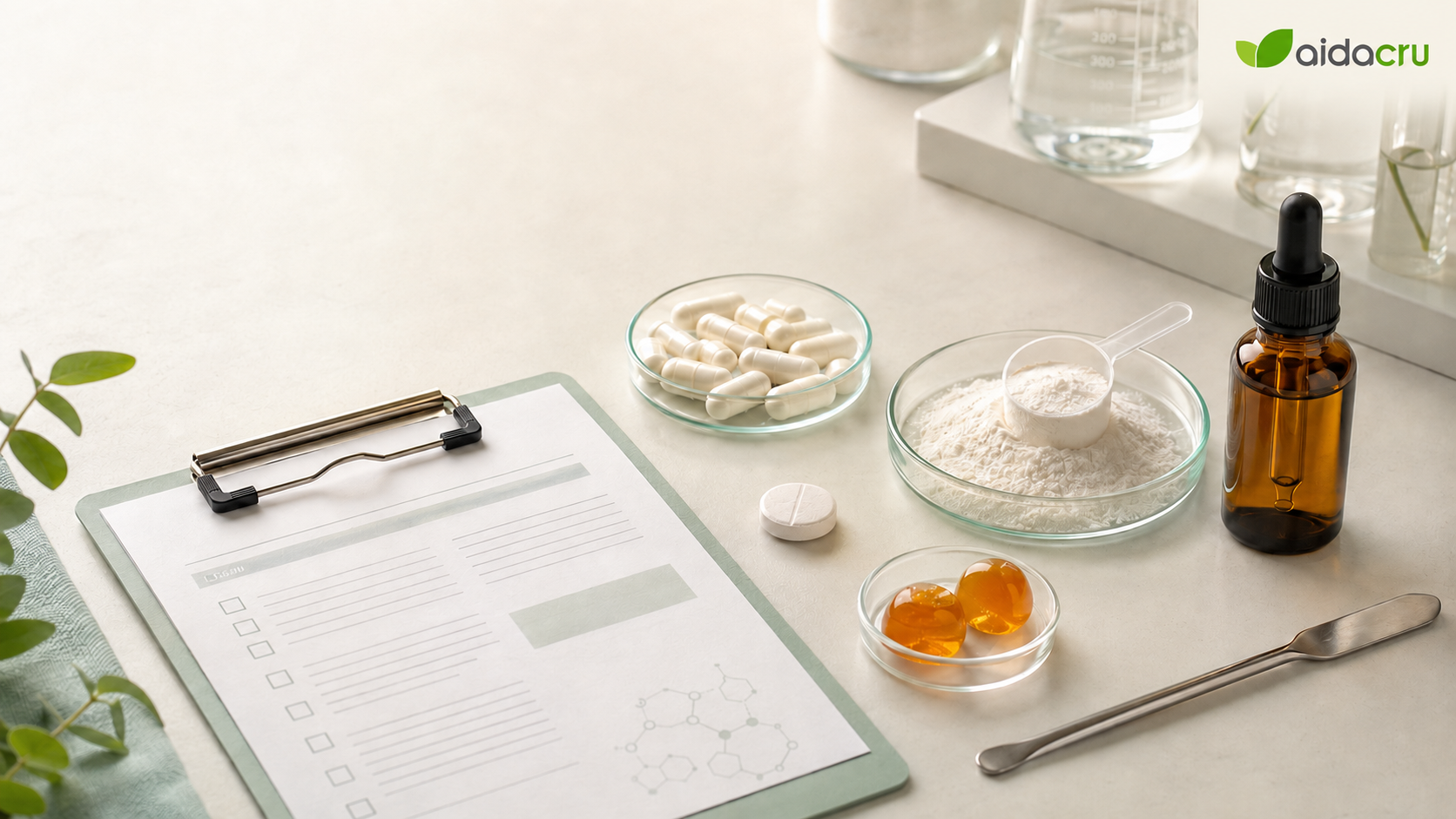
Clean-label supplement formulation is a constraint-based development process, not a simple deletion exercise. Before removing a glidant, lubricant, binder, carrier, anti-caking agent, sweetener, color, flavor, or preservative system, identify its function in the formula and process. Then select an alternative formula or process route, make a representative sample, test the attributes most likely to change, and approve the revised version in the intended package.
A “zero-additive” goal may not be technically appropriate for every formula or dosage form. The most defensible clean-label product is not the one with the fewest words at any cost. It is the one whose ingredient choices, production process, label language, and shelf-life basis all agree.
Clean Label Is a Market Position, Not One Universal Technical Standard
In the U.S. supplement market, “clean label” is commonly used to describe preferences such as a shorter ingredient list, recognizable ingredients, selected exclusions, plant-based positioning, or added transparency. It is not one universal formula specification.
That creates a practical problem for manufacturers: two brands can both request “clean label” while meaning very different things.
One may prohibit artificial colors. Another may exclude magnesium stearate. A third may require vegan capsule shells and no major allergens. A fourth may want no added sweeteners but accept a carrier required for a standardized botanical extract.
The brand should therefore convert the marketing phrase into a written formulation brief:
Ingredients that are prohibited
Ingredients that are preferred
Claims or certifications that require evidence
Target dosage form and serving size
Flavor, color, and texture expectations
Target market and label rules
Package and shelf-life objective
Commercial priorities: label simplicity, sensory quality, dose, cost, or production robustness
Without that brief, “clean label” becomes an open-ended instruction that different teams interpret differently.
Why Excipients Are Used in Supplement Manufacturing
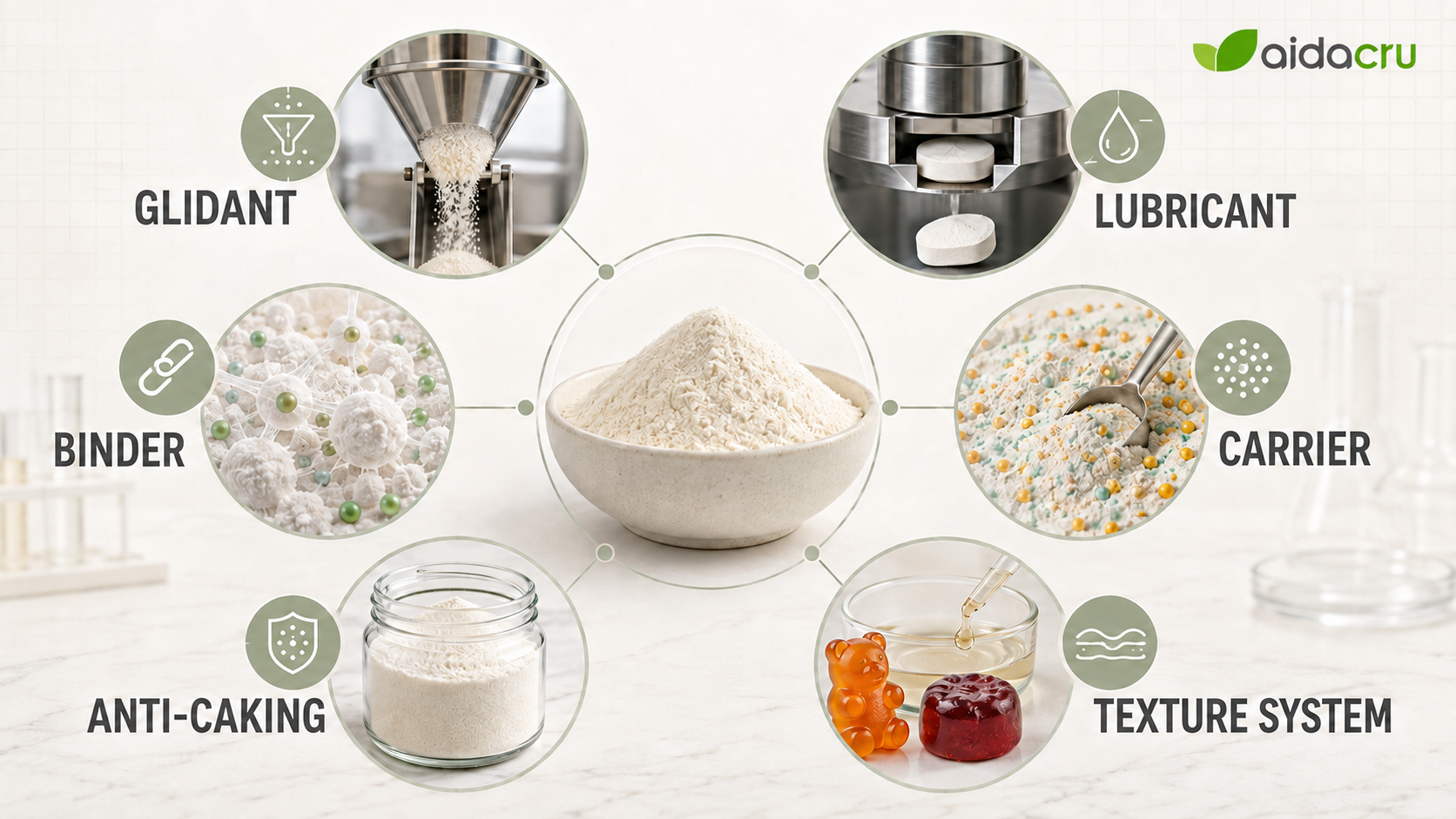
Excipients and other non-active ingredients are not automatically unnecessary fillers. Their role depends on the formula.
| Function | Why it may be used | What can happen if it is removed without redesign |
|---|---|---|
| Glidant | Helps cohesive powder move through hoppers and feeders | Bridging, inconsistent feeding, or fill-weight variation |
| Lubricant | Reduces friction and sticking during tablet compression or capsule production | Sticking, difficult ejection, tooling buildup, or damaged units |
| Binder | Helps particles form and retain a tablet or granule structure | Weak tablets, friability, capping, or inconsistent granules |
| Carrier or diluent | Standardizes an extract, distributes a low-dose ingredient, or provides workable volume | Poor content distribution, incorrect calculation, or process difficulty |
| Anti-caking agent | Helps powder remain free-flowing during storage and filling | Caking, bridging, or poor scoopability |
| Disintegrant | Helps a tablet break apart under defined conditions | Slow or inconsistent disintegration |
| Sweetener, flavor, or acid system | Builds an acceptable sensory profile | Bitterness, metallic notes, or poor repeat-purchase experience |
| Hydrocolloid or texture system | Builds gummy or liquid structure | Syneresis, weak gel, sedimentation, or unacceptable texture |
The terms used in pharmaceutical research do not turn a supplement formula into a drug product. They describe material functions that can still be relevant to supplement manufacturing.
The Same Exclusion Creates Different Risks by Dosage Form
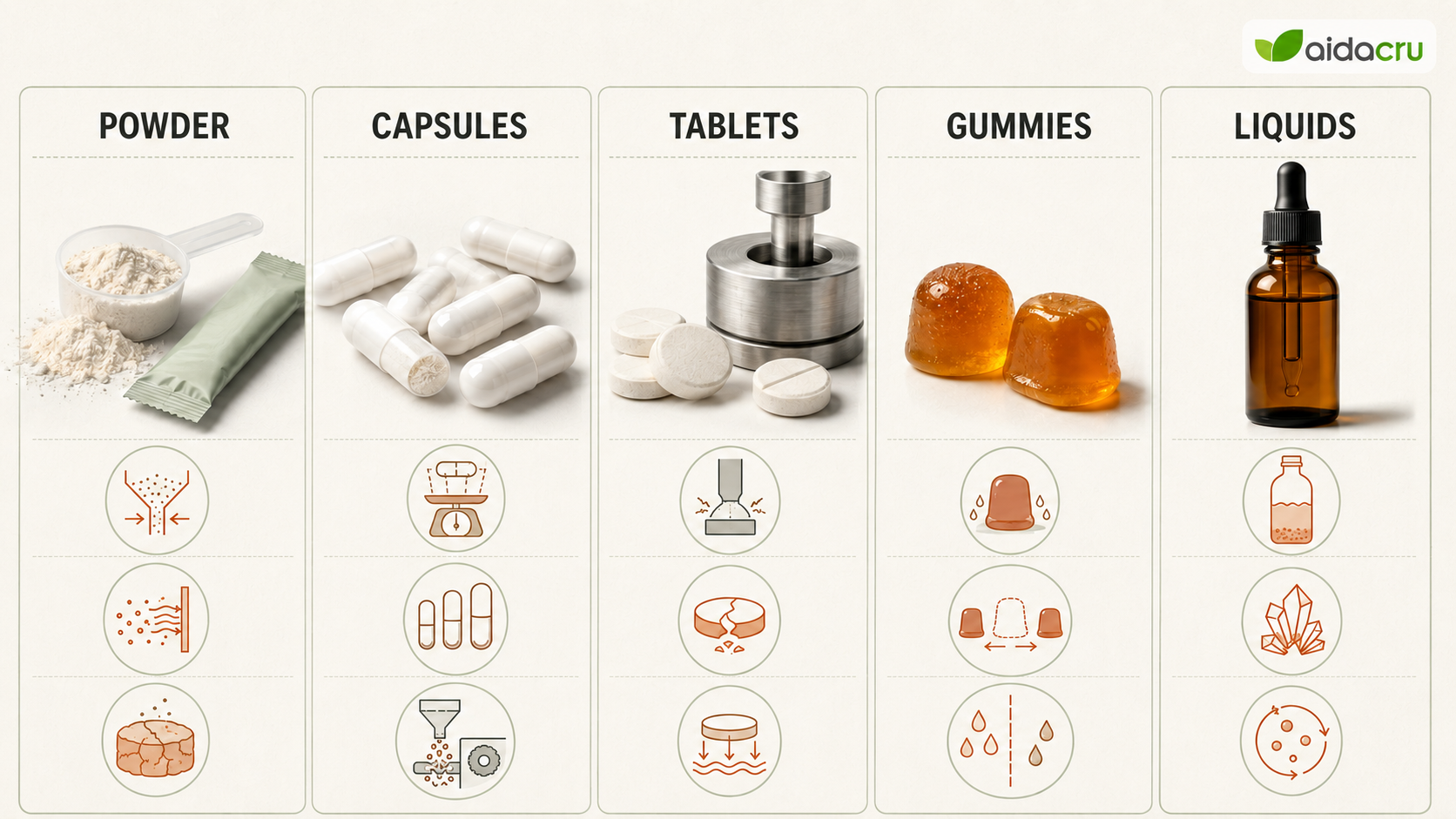
Powders and Stick Packs
Removing a glidant or anti-caking agent may change how a hygroscopic or cohesive blend moves through the hopper and dosing system. A powder that fills correctly on a bench scale may bridge, pulse, or create dust at commercial speed.
Buyer consequence: fill variation, seal-area contamination, slow line speed, rework, or a different package size.
Buyer action: compare powder flow, density, moisture behavior, dose volume, dusting, and seal performance in the intended format.
Capsules
Capsule filling depends on powder density, flow, friction, compressibility, machine principle, speed, and target fill mass. Research has linked powder-flow properties to capsule weight and weight variability. Removing or changing a flow aid can therefore affect more than manufacturing convenience.
Buyer consequence: a serving that no longer fits the selected shell size or a filling process that needs reformulation or different settings.
Buyer action: confirm capsule size, fill mass, density range, and filling performance after the revision.
Tablets
Direct compression requires a workable balance of flow, compactability, lubrication, disintegration, and mechanical strength. Glidant and lubricant concentration, mixing order, and mixing time can influence powder and tablet properties. More lubricant is not always better; less is not automatically cleaner or stronger.
Buyer consequence: sticking, picking, capping, weak tablets, slow disintegration, or an unstable process window.
Buyer action: define the tablet attributes that must be preserved, then evaluate the revised formula and process together.
Gummies and Soft Chews
A hydrocolloid, sugar system, polyol, acid, oil, emulsifier, or coating component may affect gel formation, moisture migration, sticking, flavor release, and texture over time. Research on plant-based gummy systems shows that hydrocolloid type and concentration can materially change gel strength and water seepage.
Buyer consequence: an acceptable first sample that hardens, softens, sweats, or sticks during storage.
Buyer action: approve texture against defined criteria and evaluate the intended package, not only the fresh sample.
Liquids and Drops
A clean-looking ingredients list does not eliminate the need to control solubility, suspension, pH, oxidation, flavor, and microbiological risk where relevant. Removing a solubilizer, stabilizer, antioxidant, or preservation element can change the physical state of the product.
Buyer consequence: separation, precipitation, color change, dosing inconsistency, or a shorter usable life.
Buyer action: define whether the product is intended to be a solution, emulsion, or suspension and how the consumer will use it.
A Function-First Reformulation Workflow
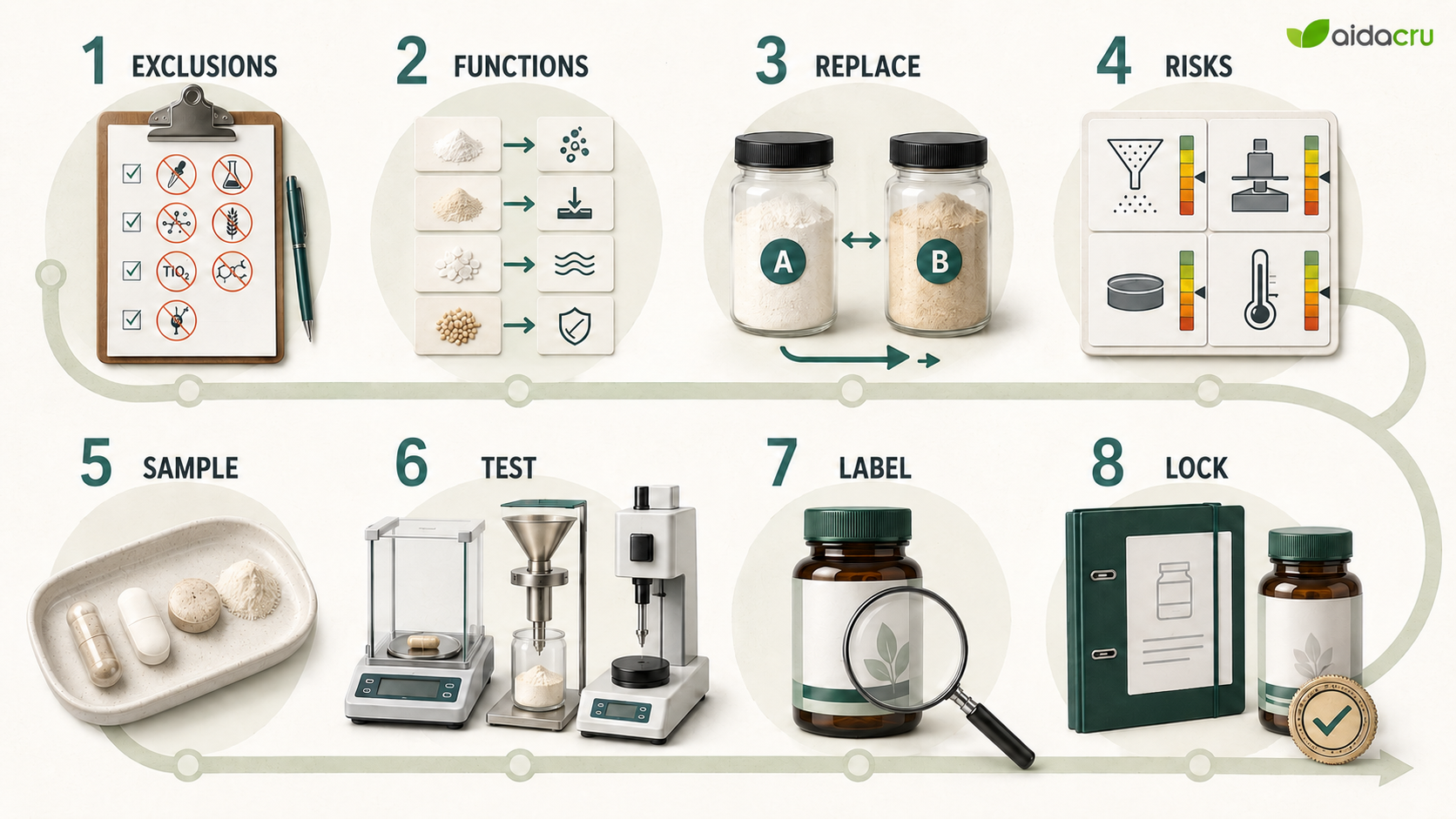
Step 1: Write the Exclusion List
Separate non-negotiable exclusions from preferences. “No artificial colors” is clearer than “make it natural.” Include market, retailer, certification, allergen, and brand-policy constraints.
Step 2: Map Every Ingredient to a Function
For each ingredient proposed for removal, document what it does in the formula, process, package, or user experience. One ingredient may perform several jobs.
Step 3: Choose the Replacement Route
Common routes include:
Use a different grade of the active or base material
Change particle size or granulation
Use an alternative functional ingredient
Modify the mixing order or process
Change the dosage form or serving size
Change the package or storage statement
Accept a documented trade-off in appearance, texture, or cost
Do not present any route as universally superior. The best choice depends on the formula and target market.
Step 4: Define the New Failure Modes
Removing an ingredient changes the risk assessment. Identify what may now fail: flow, blend uniformity, fill weight, compression, disintegration, texture, dispersion, flavor, oxidation, microbiology, or package performance.
Step 5: Make a Representative Sample
A sample should use the approved formula version and answer the intended question. A hand-filled capsule can support sensory or appearance review but may not prove commercial filling performance.
Step 6: Test the Revised Product and Process
Select tests and in-process checks that address the new risks. Do not copy a generic panel without explaining what decision each result supports.
Step 7: Review the Label and Claims
Confirm the Supplement Facts calculation, other-ingredients list, allergen statement, certifications, and marketing language. Ingredient transparency does not permit unsupported “free-from,” organic, non-GMO, or health claims.
Step 8: Lock the Approved Version
Connect the formula, raw-material grades, sample, process conditions, specifications, package, label, and approval record. If one changes, determine whether re-evaluation is needed.
Clean-Label Trade-Off Table for Buyers
| Brand request | Technical question | Possible commercial consequence |
|---|---|---|
| Remove silicon dioxide or another flow aid | Can the blend feed consistently without it? | Slower filling, weight variation, or caking |
| Remove magnesium stearate or another lubricant | How will tooling friction and sticking be controlled? | Compression interruption, appearance defects, or damaged tablets |
| Remove a binder | Can the tablet or granule retain adequate strength? | Breakage, dust, or packaging loss |
| Remove a carrier | Can the active still be standardized and distributed uniformly? | Formula recalculation or content-uniformity risk |
| Replace artificial color or flavor | Does the alternative tolerate the process and shelf-life conditions? | Color drift, flavor instability, or higher cost |
| Remove a preservation element | What controls the revised product’s microbial and chemical stability? | Shorter usable life or a different package/process need |
What to Send a Manufacturer
Desired clean-label position in one sentence
Non-negotiable exclusions and preferred ingredients
Complete formula or ingredient concept
Target serving size and dosage form
Target market and sales channel
Required claims or certifications, with evidence expectations
Sensory benchmark
Final retail package concept
Target shelf life and storage conditions
Forecast and launch timing
Benchmark product, if available
Common Clean-Label Mistakes
Treating Every Excipient as a Filler
This ignores flow, compression, distribution, texture, and stability functions.
Promising “Zero Additives” Before the Formula Is Developed
The claim may conflict with the selected extract grade, dosage form, flavor target, or production process.
Approving Only the Fresh Sample
Fresh appearance and taste do not establish production performance or shelf-life behavior.
Changing the Ingredient but Keeping the Old Label and Specification
The revised formula must be connected to its new ingredient list, calculations, specifications, sample, and approval record.
Frequently Asked Questions
What does clean label mean for a supplement brand?
It is a brand-defined position, often involving ingredient simplicity, selected exclusions, sourcing transparency, or dietary preferences. Convert it into written requirements before formulation begins.
Are excipients bad or unnecessary?
No. Some provide essential functions such as flow, lubrication, binding, distribution, disintegration, flavor, or texture. Each ingredient should be justified for the product.
Can a supplement be made without magnesium stearate?
Sometimes, but feasibility depends on the dosage form, formula, raw-material properties, equipment, process, and acceptance criteria. Removing it may require a different lubricant or process route.
Can silicon dioxide be removed from a powder?
Possibly. First determine whether the blend remains free-flowing and fillable and whether caking or dusting changes during storage and production.
Does fewer ingredients mean a more stable product?
Not necessarily. Removing a stabilizing, structural, or processing function can reduce stability or manufacturability. Stability must be evaluated for the revised formula and package.
Is a natural alternative always a one-for-one replacement?
No. Alternatives may have different potency, flavor, color, particle size, moisture sensitivity, regulatory status, or processing behavior.
Should clean-label claims be finalized before sampling?
Define the intended position early, but finalize claims only after formula composition, supplier documentation, target-market requirements, and evidence have been reviewed.
What information should Aidacru receive for a clean-label review?
Send the exclusion list, formula, serving size, dosage form, target market, package, shelf-life goal, forecast, and launch timing. Final feasibility, tests, MOQ, timing, and claims remain subject to project confirmation.
Build a Cleaner Label Without Hiding the Manufacturing Trade-Offs
Clean-label development is strongest when the label promise and production reality are designed together. Start with the consumer and retailer requirements, map the technical functions, test the revised formula, and document the version that will be produced.
Next step: Send us your exclusion list, formula or ingredient concept, target serving, dosage form, package, market, forecast, and launch timing. We’ll identify which ingredient functions, process risks, and approval questions should be addressed before the formula is locked.