

High trend signal: GLP-1 companion nutrition is expanding from digestive comfort into protein and muscle-support positioning.
Research signal: Recent reviews emphasize adequate protein and resistance exercise during GLP-1-assisted weight reduction.
Commercial intent: Brands search for differentiated GLP-1 supplement OEM concepts rather than another generic weight-management product.
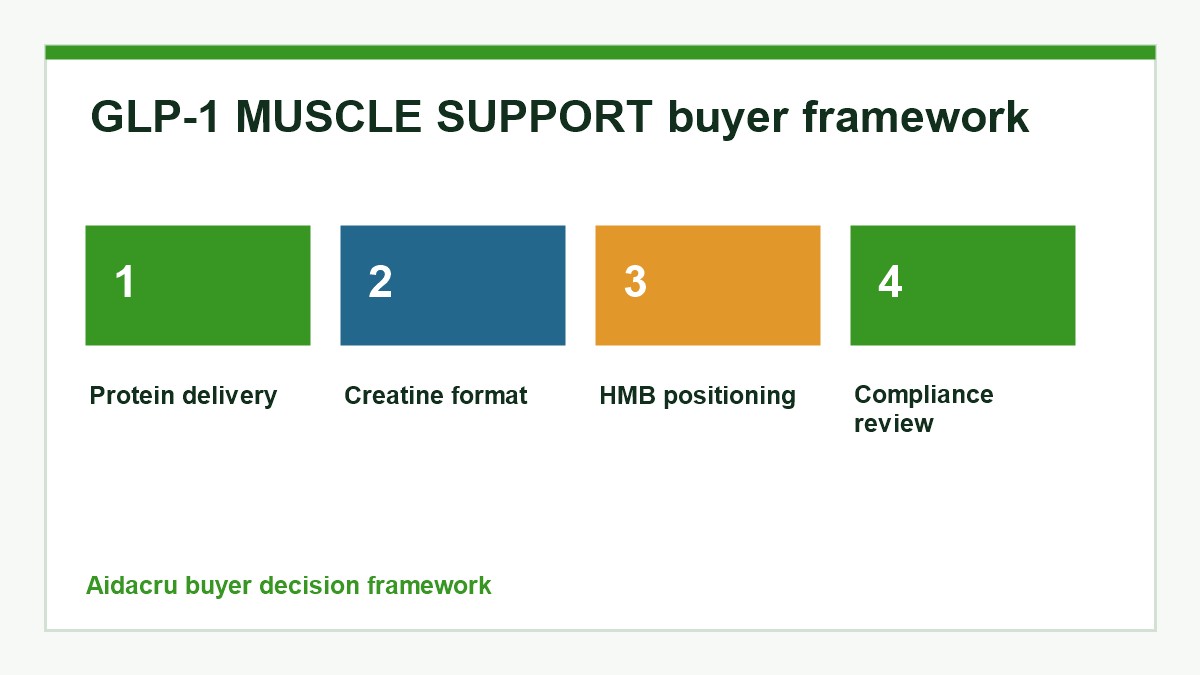
Why Muscle-Support Positioning Is Growing
Weight loss commonly includes reductions in both fat mass and lean mass. Peer-reviewed discussions of GLP-1 therapy therefore emphasize resistance exercise and adequate protein intake. This does not mean a supplement can guarantee muscle preservation. It means brands can build responsible products around convenient nutrition routines, workout support and normal muscle function.
| Formula route | Commercial role | Manufacturing reality |
|---|---|---|
| Protein powder or clear protein | Convenient protein intake when appetite is lower. | Powders carry useful serving sizes more efficiently than capsules or gummies. |
| Creatine monohydrate | Strength-training and performance-support positioning. | Powder is straightforward; gummies require loading, texture and stability review. |
| HMB | Premium muscle-health differentiation. | Taste, dose, calcium contribution and format must be checked early. |
| Vitamin D, magnesium and B vitamins | Daily nutrition and normal muscle-function support. | Use levels, interactions, flavor and label space influence the format. |
Three Product Architecture Options
1. Protein + Creatine Daily Powder
This route offers the clearest serving-size economics. It can use whey, plant protein or clear-protein systems, with creatine and selected micronutrients. The main development challenges are flavor, sedimentation, scoop size and packaging moisture control.
2. Creatine + HMB Gummies
Gummies provide strong repeat-use appeal, but active loading is the constraint. A brand must decide whether the product is a full-dose formula, a split serving or a convenience-led complementary format. Avoid designing the label before confirming the real achievable dose.
3. Capsule Companion Pack
A capsule system can combine HMB, vitamins and minerals, but it cannot efficiently replace meaningful protein intake. Position it as a daily companion pack, not as a protein substitute.
Claims and Compliance Boundary
Safer language includes “supports normal muscle function,” “supports strength-training nutrition,” and “helps maintain daily protein routines.” Avoid claims that the product prevents sarcopenia, reverses muscle loss caused by a prescription drug or guarantees weight-loss quality. FDA explains that structure/function claims describe support for normal body structure or function and must be truthful and substantiated.
OEM Buyer Checklist
- Define the target serving size before choosing the dosage form.
- Separate protein-delivery goals from capsule or gummy convenience goals.
- Confirm creatine and HMB source, specification and test methods.
- Review taste masking, water activity and stability requirements.
- Prepare compliant structure/function language before packaging design.
- Plan a pilot sample and sensory review before bulk production.
How Aidacru Can Support the Project
Aidacru can help compare powder, gummy and capsule routes, source ingredients, review sample feasibility and connect the formula to packaging and MOQ planning. This article expands the existing GLP-1 content cluster without competing with the digestive-support article.
Related: GLP-1 companion supplement pillar · GLP-1 digestive support guide · Creatine product option · Request an OEM review.
Primary Sources and Market Evidence
- https://pmc.ncbi.nlm.nih.gov/articles/PMC11611443/
- https://www.fda.gov/food/nutrition-food-labeling-and-critical-foods/structurefunction-claims
Frequently Asked Questions
What supplements are commonly considered for GLP-1 muscle-support formulas?
Common B2B formula routes include protein powders, creatine, HMB, amino-acid positioning and selected vitamins or minerals. The correct combination depends on dosage form, serving size and claims.
Can a gummy deliver a full protein serving?
Generally no. Gummies are better suited to selected actives and convenience positioning, while powders are more practical for meaningful protein serving sizes.
Can Aidacru manufacture GLP-1 companion supplements?
Aidacru supports OEM and ODM development across powders, gummies, capsules and other supplement formats, including formulation feasibility, sampling, packaging and MOQ planning.