

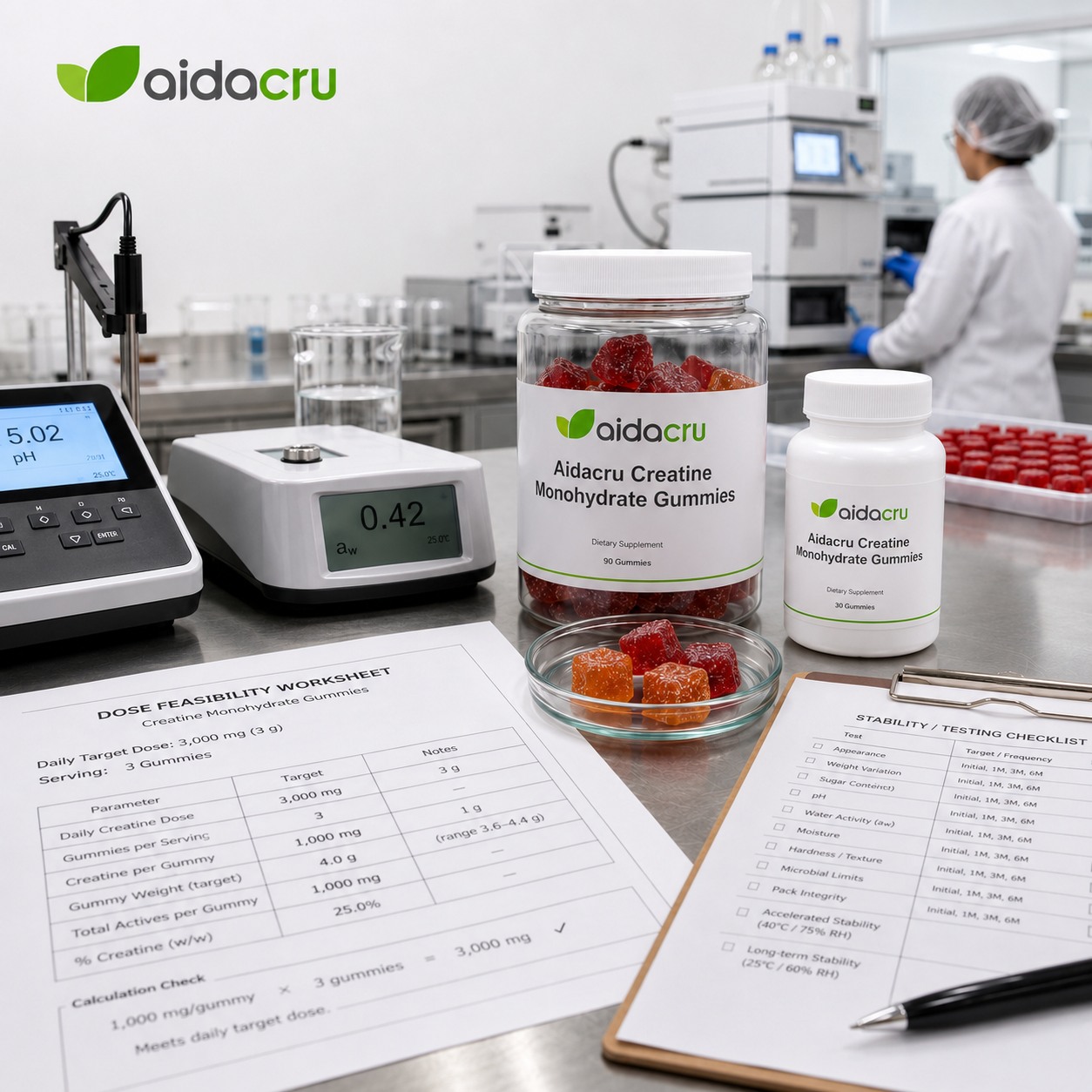
Quick answer: A creatine gummy project should not begin with flavor, bottle design or a "5 g" front-label concept. It should begin with four questions: What exactly will the label declare? How much active must fit into each serving? Can the selected gummy system protect that active through manufacturing and shelf life? Which analytical method will verify both creatine and its degradation product, creatinine?
Creatine gummies can offer a portable, differentiated alternative to powder. They also combine a gram-level sports-nutrition ingredient with a moisture-containing, heat-processed confectionery system. That creates formulation and testing risks that do not exist to the same degree in a dry creatine powder.
For a U.S. brand, a credible creatine gummy is therefore not simply a gummy with creatine added. It is a finished product supported by dose calculations, controlled processing, packaging-specific stability work and test results that match the exact label claim.
Why Creatine Gummies Are Receiving More Scrutiny
The commercial opportunity is easy to understand. Creatine is familiar to sports-nutrition consumers, while gummies remove the scoop-and-mix step and create a product that is easier to carry and demonstrate in digital content.
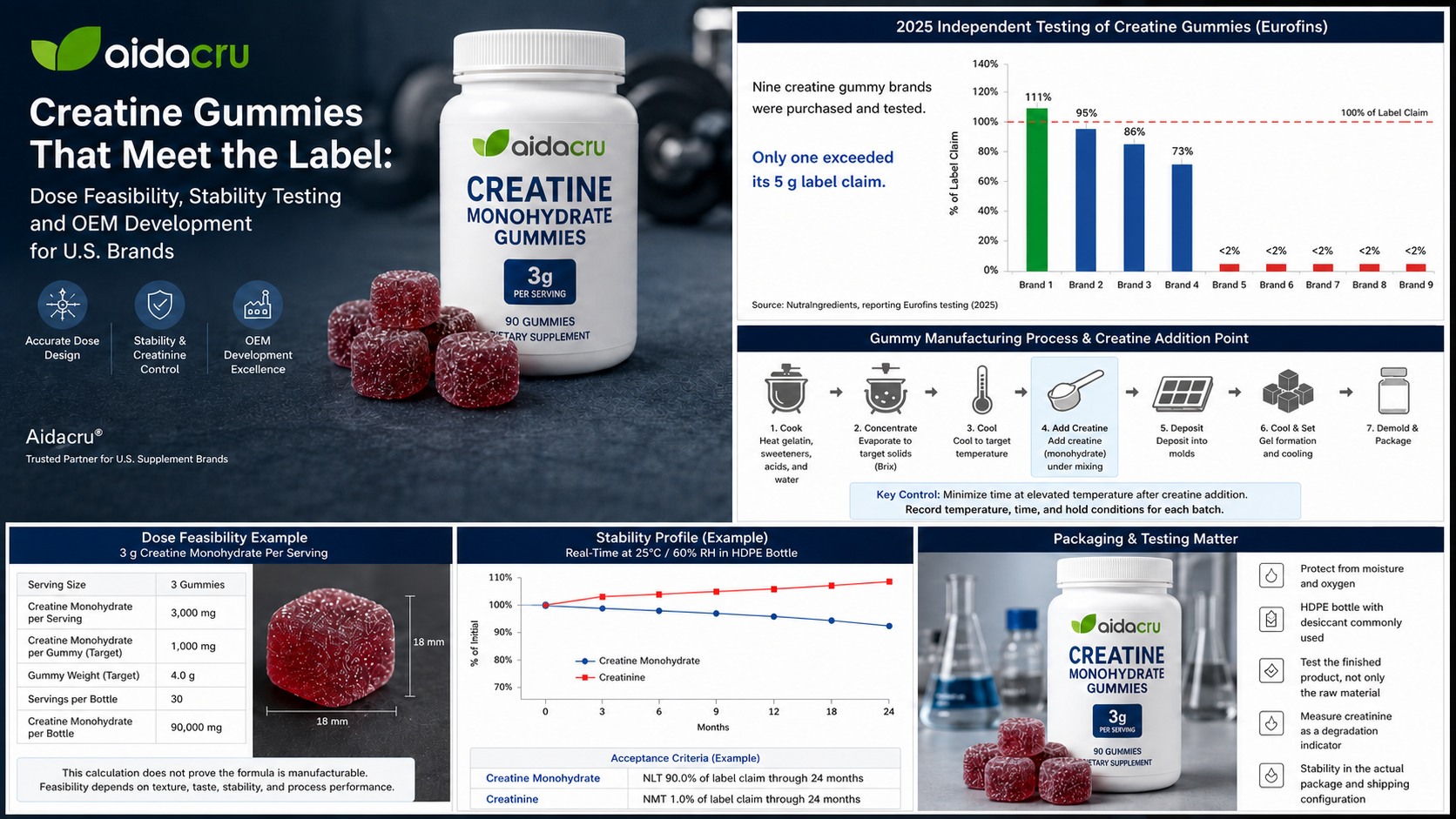
The quality problem is equally important. In a 2025 industry report, nine creatine gummy brands were purchased and tested by Eurofins. Only one exceeded its 5 g label claim. Three contained 95%, 86% and 73% of the declared amount, while five contained less than 2% of the claim.
This does not prove that creatine gummies are impossible to manufacture. It proves that formulation appearance and label copy are not enough. A brand needs evidence that the finished gummy contains the declared active at release and continues to meet the agreed specification during shelf life.
What a buyer should learn from these failures
Test the finished product, not only the incoming creatine powder.
Make the analytical specification match the wording used on the label.
Measure creatinine when degradation is a known project risk.
Do not assume a laboratory sample will behave exactly like a production batch.
Confirm stability in the actual bottle, pouch, closure and shipping configuration.
Start With the Evidence-Based Serving, Then Work Backward
The NIH Office of Dietary Supplements notes that creatine is mainly associated with repeated short-duration, high-intensity activity. Its professional fact sheet describes a commonly studied maintenance intake of approximately 3-5 g/day after an optional loading phase. Creatine monohydrate is also identified as the most widely used and studied form.
That scientific background is not permission to place any number on a gummy label. The brand must first define what the number represents.
| Specification question | Why it must be settled before formulation |
|---|---|
| Is the declaration for creatine monohydrate or creatine? | Creatine monohydrate is not 100% creatine by weight. The test specification and label wording must use the same basis. |
| What is the target amount per serving? | This determines total active load, serving count and commercial relevance. |
| How many gummies make one serving? | More gummies can improve loading feasibility but may reduce convenience and increase package size. |
| What is the target gummy weight? | The active must share each piece with the gelling system, sweeteners, water, acids, flavors and processing aids. |
| What tolerance will apply at release and through shelf life? | A target without an agreed acceptance range cannot support batch release. |
A simple serving-architecture example
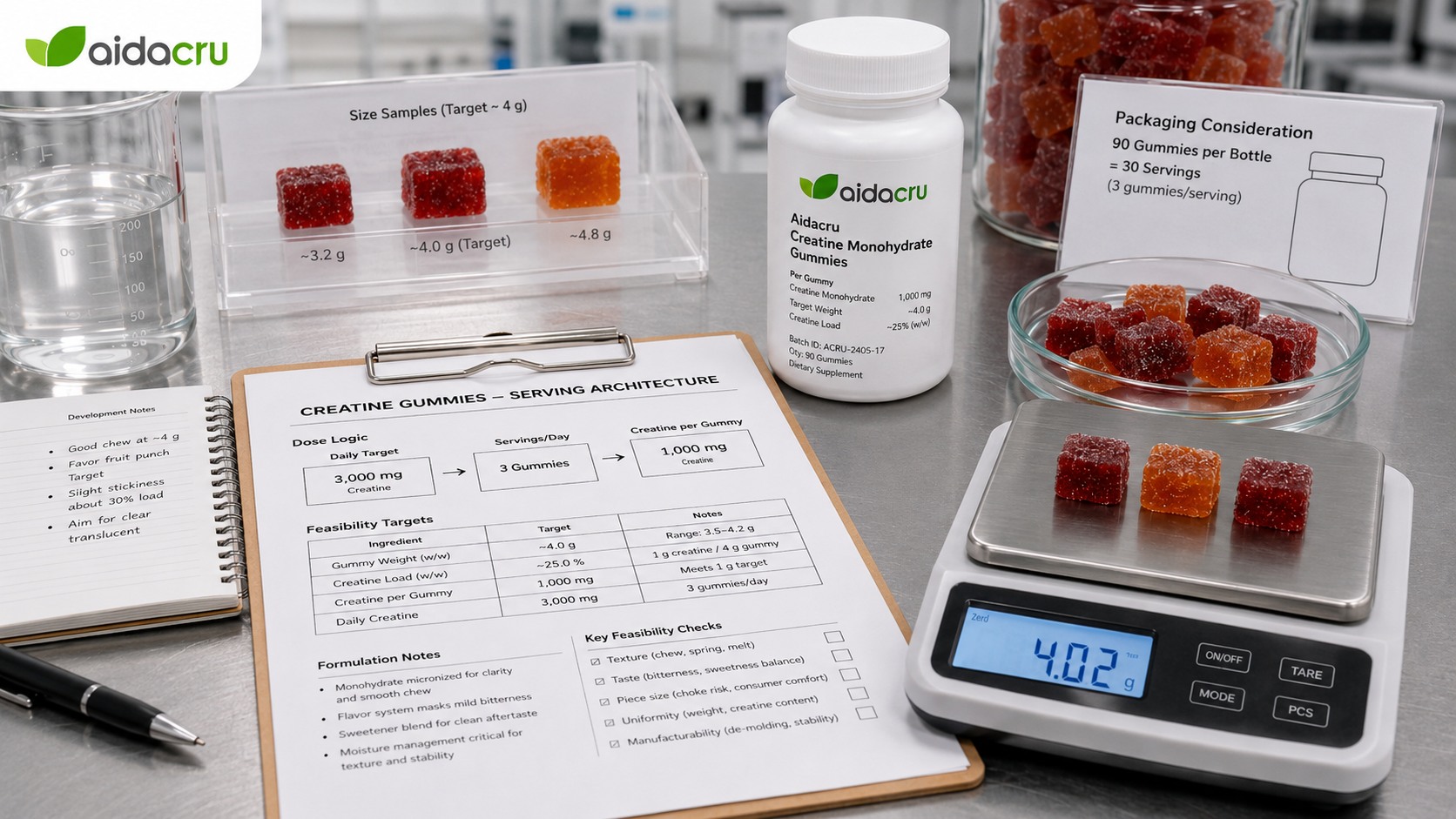
If a concept targets 3 g of creatine monohydrate per serving and uses three gummies per serving, the arithmetic target is 1 g of creatine monohydrate per gummy. That calculation does not prove the formula is manufacturable.
The development team must still determine whether the piece can maintain acceptable:
texture and chew;
depositing behavior;
weight consistency;
taste and aftertaste;
active distribution;
water activity;
potency after processing;
potency through the intended shelf life.
This is why Aidacru treats the target dose and serving count as feasibility inputs, not as final claims.
The Four Main Technical Risks
1. Thermal exposure
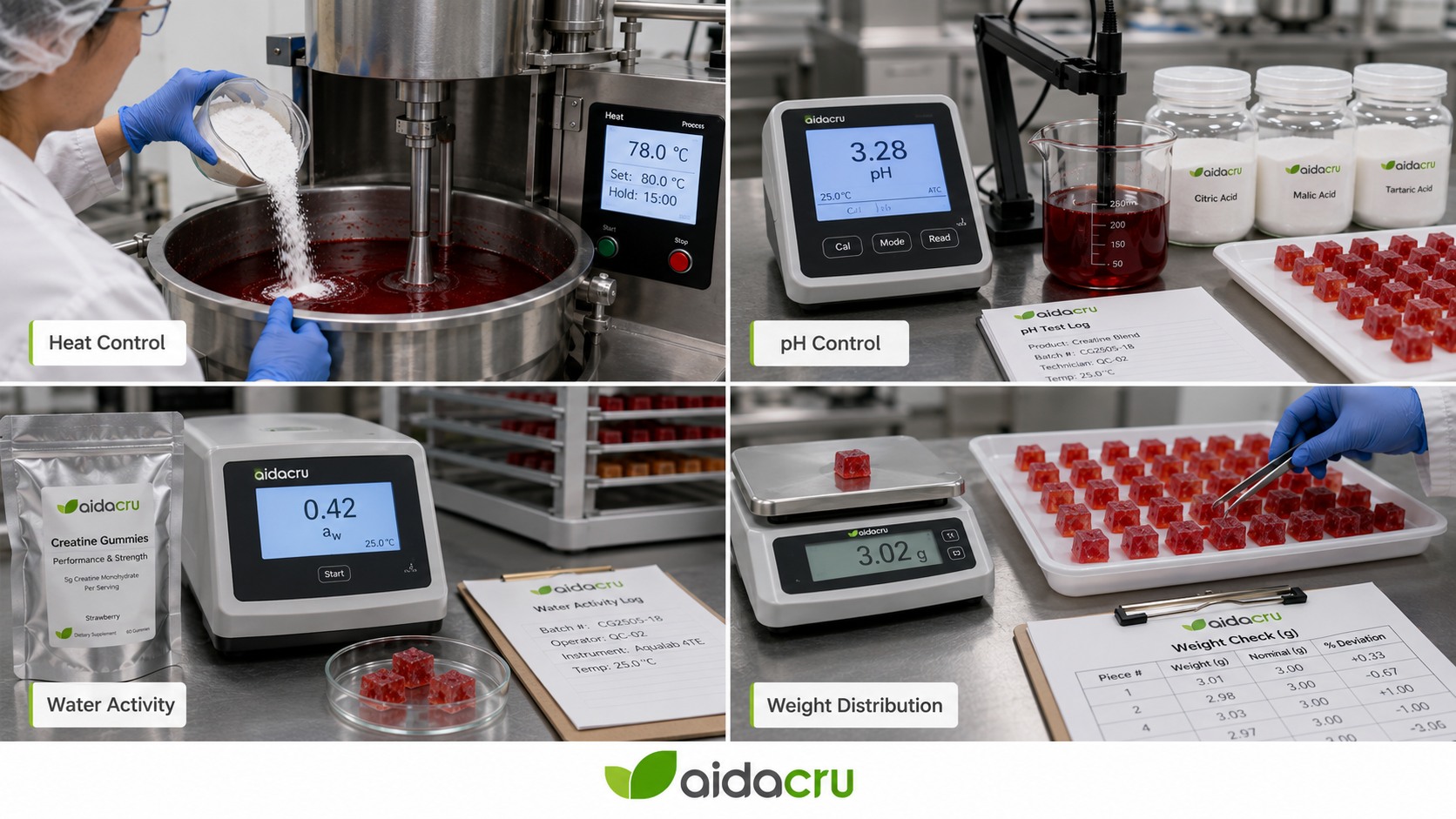
Creatine is stable as a dry solid, but a gummy process introduces water and elevated temperature. The relevant risk is not only the highest temperature shown on an equipment screen. Total exposure depends on when creatine is added, how long it remains in the hot mass, cooling time and whether material is held during a production interruption.
The development record should therefore capture:
creatine addition point;
product temperature at addition;
maximum exposure temperature;
hold time before depositing;
rework or extended-hold rules;
potency result after the pilot process.
A late-addition approach may reduce exposure in some formulations, but it must also produce acceptable dispersion and piece-to-piece consistency. It is not automatically the correct solution for every gummy line.
2. pH and acidification
Fruit-flavored gummies commonly use food acids to control taste and gel behavior. Creatine conversion to creatinine is affected by pH and temperature in aqueous systems, so acidification cannot be treated as a flavor decision alone.
The practical development question is not "Which acid tastes best?" It is:
Which acid system and pH range provide acceptable taste and gummy performance without creating unacceptable potency loss?
The answer must come from the complete formulation and stability data. A pH target taken from another brand or another gelling system is not sufficient evidence.
3. Moisture and water activity
A finished gummy can change after depositing. Moisture migration may affect texture, surface condition, microbiological risk and chemical stability. Water activity and moisture content are related measurements, but they do not describe exactly the same property.
For a creatine gummy, the development team should define:
in-process solids or Brix target where applicable;
conditioning or drying endpoint;
finished water-activity target;
finished moisture target if used;
acceptable texture range;
packaging barrier assumptions;
storage and distribution conditions used for stability work.
4. Active distribution and piece-weight variation
A high powder load can change viscosity and suspension behavior. If the active is not distributed consistently, an acceptable composite result may hide individual-piece variation.
The control strategy should connect mixing, holding, depositing and piece weight. Depending on the formula and risk assessment, the testing plan may require more than a single composite assay.
Creatine Gummy Development: From Brief to Production
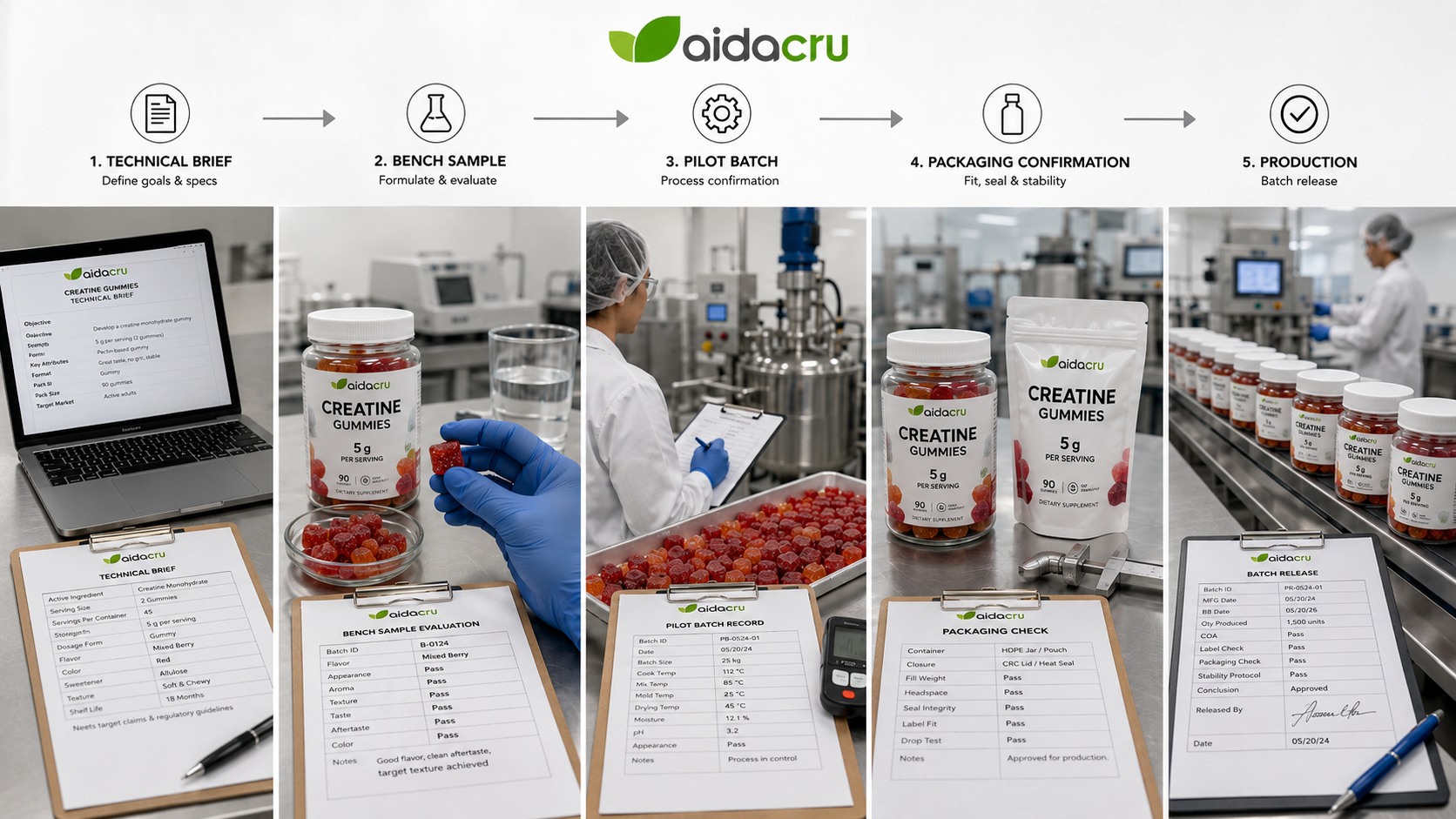
Stage 1: Technical brief
The buyer should provide:
Target market and sales channel
Intended consumer and use occasion
Creatine form and label declaration
Target amount per serving
Maximum acceptable gummies per serving
Pectin or gelatin preference
Sugar, reduced-sugar or sugar-free direction
Flavor and sweetener restrictions
Gummies and servings per container
Bottle, jar or pouch preference
Required testing and retailer documents
First-order quantity and launch timing
Without these inputs, a manufacturer may be quoting a different product from the one the brand intends to sell.
Stage 2: Bench sample
A bench sample is used to assess initial feasibility and sensory direction. It can help answer:
Does the matrix form correctly at the intended active load?
Is the serving count realistic?
Can the flavor system manage bitterness or mineral-like notes?
Is the piece size acceptable?
Does the formula show obvious separation, sweating or crystallization?
A bench sample does not by itself establish production consistency or shelf life.
Stage 3: Pilot or process-confirmation batch
The pilot should reproduce the intended manufacturing sequence closely enough to evaluate scale-sensitive risks. The team should document relevant temperatures, times, pH, solids, water activity, piece weight and yield.
Pilot evaluation should include both sensory observations and analytical results. A gummy that tastes acceptable but misses potency is not an acceptable pilot.
Stage 4: Packaging confirmation
Packaging is part of the formula's protection system. Review:
moisture and oxygen barrier;
bottle or pouch headspace;
closure and induction seal;
desiccant suitability where used;
light exposure;
count, net weight and package volume;
parcel, warehouse and summer-distribution conditions.
The stability sample should use the intended commercial packaging or a technically justified equivalent.
Stage 5: Production and batch release
The production specification should connect the approved formula, master manufacturing record, in-process controls, finished-product tests and label.
Under U.S. dietary supplement CGMP requirements in 21 CFR Part 111, quality cannot be reduced to a certificate placed on a sales page. Specifications, manufacturing records, quality-control review and release documentation must operate together.
Minimum Testing Plan for a Serious Creatine Gummy Project
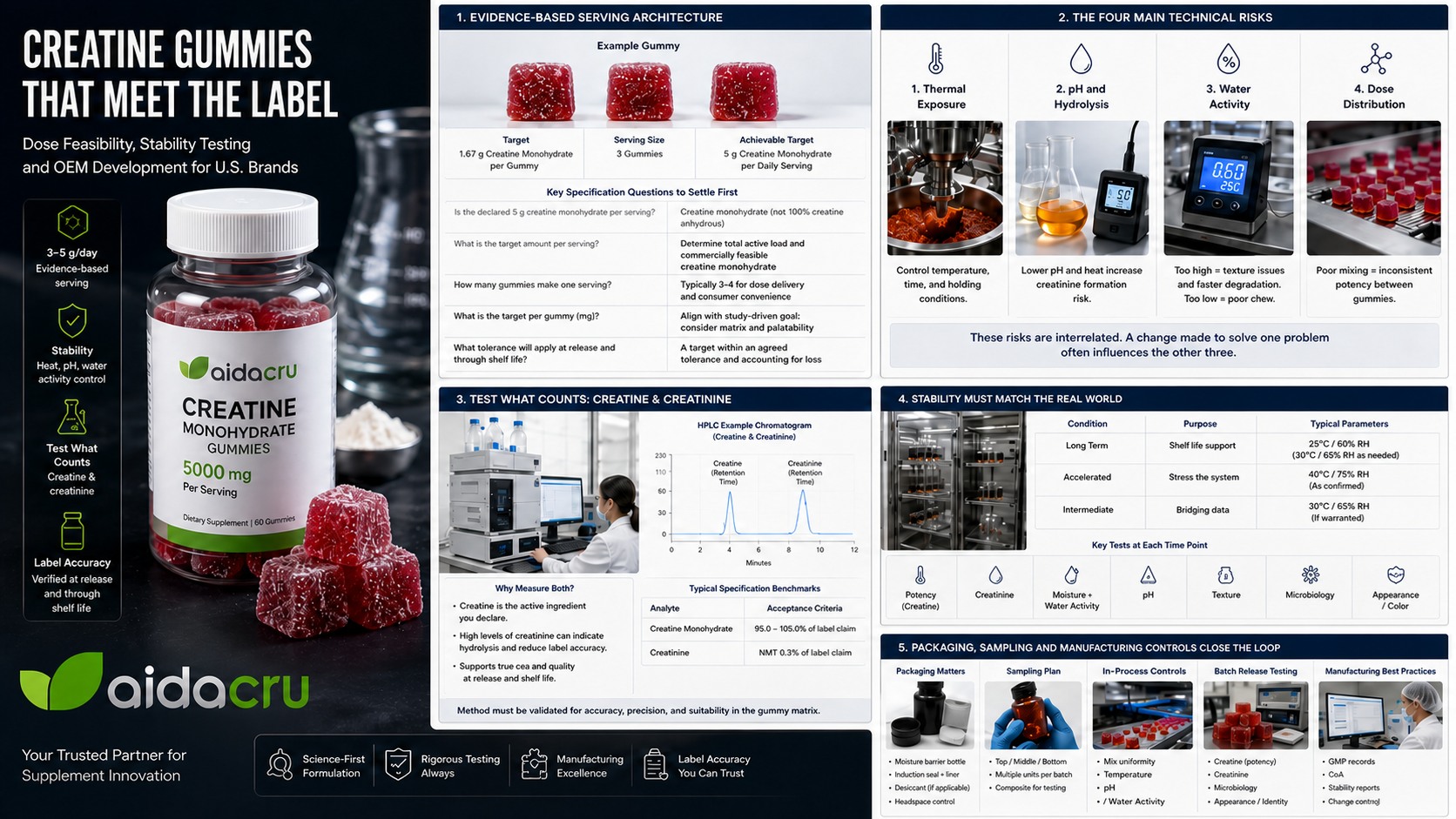
The exact specification should be determined by the formula, market and qualified laboratory. The following framework gives buyers a practical starting point.
| Stage | Suggested review | Business question answered |
|---|---|---|
| Incoming creatine | Identity, supplier COA review and applicable purity specification | Did the correct raw material enter the process? |
| Pilot batch | Creatine assay, creatinine where appropriate, pH, water activity, piece weight and sensory review | Did the proposed process make the intended product? |
| Finished batch | Potency, relevant uniformity plan, microbiological testing and applicable contaminant testing | Can quality control release this batch against the written specification? |
| Stability program | Creatine and creatinine trend, water activity/moisture, texture, appearance, odor and microbiological risk as applicable | Will the packaged product remain within specification through shelf life? |
| Packaging verification | Seal integrity, closure compatibility and distribution-condition review | Can the package protect the product in the intended channel? |
Why creatinine should be discussed
Testing only creatine tells the brand how much target active remains. Measuring creatinine can provide additional information when the team is investigating whether potency loss is associated with degradation.
The laboratory method, sample preparation and reporting basis must be suitable for a gummy matrix. A method designed for a simple powder should not be assumed to perform identically in a pectin- or gelatin-based product containing flavors, acids, colors and sweeteners.
Real-Time and Accelerated Stability Are Not Interchangeable
Accelerated studies can identify risk and support development decisions, but they are not a universal substitute for real-time evidence. Food Supplements Europe's GMP guide notes that multi-ingredient products may require several assays because ingredients can degrade at different rates, and that undue reliance should not be placed on accelerated testing alone.
For a creatine gummy, the written protocol should define:
storage conditions;
commercial package configuration;
test intervals;
active and degradation measurements;
physical and microbiological attributes;
acceptance criteria;
actions if a trend approaches the limit.
Shelf life should be assigned from relevant data, not copied from a standard gummy formula.
Creatine Gummies vs Creatine Powder: The Manufacturing Decision
| Decision factor | Creatine gummies | Creatine powder |
|---|---|---|
| Gram-level serving | Limited by piece size and gummy matrix | Easier to deliver with a scoop or sachet |
| Process exposure | Water, heat, acidification and conditioning must be controlled | Primarily dry blending and moisture control |
| Consumer routine | Portable and chewable | Requires mixing unless supplied in another format |
| Sensory work | Flavor, texture and aftertaste are central | Flavored or unflavored options; solubility matters |
| Packaging | Bottle, jar or barrier pouch; moisture protection is critical | Tub, pouch or stick pack |
| Testing focus | Potency, degradation, physical stability and piece consistency | Identity, potency, blend uniformity and moisture |
| Commercial question | Will consumers pay for convenience and differentiation? | Can the brand differentiate a familiar commodity format? |
The strongest format is the one that can deliver the required serving, remain within specification and support the brand's channel economics.
U.S. Claims and Label Review
Creatine has a meaningful body of research, but research on an ingredient does not automatically substantiate every claim for every finished product.
FTC guidance requires objective health-related claims to be supported by competent and reliable scientific evidence. FDA also distinguishes permissible structure/function language from disease claims and requires qualifying conditions for structure/function claims used in dietary supplement labeling.
Potentially supportable direction, subject to final review
supports training performance;
supports strength and power during high-intensity exercise;
supports an active lifestyle;
convenient creatine delivery format.
Avoid without appropriate product-specific substantiation
guaranteed muscle gain;
instant results;
clinically proven when only the raw ingredient was studied;
superior absorption compared with powder without comparative evidence;
"5 g per serving" when release and stability results do not support the declaration;
disease, treatment or hormone claims.
The overall impression created by the product name, label, images, testimonials and website copy must also remain truthful. A disclaimer does not correct an otherwise misleading message.
Questions to Ask a Creatine Gummy Manufacturer
Has the target active load been produced in this specific gummy system?
When is creatine added, and how are temperature and hold time controlled?
How are pH, solids, water activity and piece weight monitored?
Which method and laboratory will test creatine?
Will creatinine also be measured where appropriate?
How is representative sampling defined?
What is the difference between the bench sample and production process?
Which packaging configuration is included in stability work?
What acceptance criteria apply at release and through shelf life?
Who reviews deviations and approves the finished batch for release?
How Aidacru Reviews a Creatine Gummy Project
Aidacru can review creatine gummy OEM/ODM projects for U.S.-market brands based on the target serving, gummy count, gelling system, flavor direction, packaging and required documentation.
The working sequence is:
Buyer brief and feasibility review
Formula and serving-architecture discussion
Sample development and sensory feedback
Packaging and testing confirmation
Production planning after formula and artwork approval
Finished-batch quality review and delivery coordination
Aidacru's starting MOQ can be as low as 200 retail units for qualifying projects and packaging configurations. Existing-formula samples are generally prepared in 3-7 natural days, while custom-formula samples generally require 7-15 natural days. Final MOQ, testing scope, sample timing and production timing depend on the formula, active load, packaging, raw-material availability and approval requirements.
These ranges are planning references, not guaranteed outcomes for every creatine gummy specification.
Frequently Asked Questions
Can a creatine gummy provide a 3-5 g daily serving?
It may be possible through multiple gummies, but feasibility depends on the active basis, gummy weight, matrix, sensory target and processing behavior. Arithmetic alone does not confirm manufacturability or shelf stability.
Why do some creatine gummies fail label-claim testing?
Possible causes include inadequate initial loading, process loss, degradation, non-representative sampling, unsuitable analytical methods or poor control of active distribution. A root-cause investigation requires batch and test data.
Is creatine monohydrate suitable for gummies?
Creatine monohydrate is the most widely studied creatine form, but a gummy project must still demonstrate process compatibility, potency and stability in the finished matrix.
Should creatinine be included in the test panel?
It should be discussed when degradation is a material risk or when potency loss requires investigation. The final test panel should be agreed with quality and a qualified laboratory.
Are pectin creatine gummies possible?
Pectin can support a vegan positioning route, but active load, pH, gel behavior, water activity, taste and stability must be developed as one system.
Does an accelerated stability test prove a two-year shelf life?
Not automatically. Accelerated data must be interpreted using a justified protocol and should normally be supported by real-time evidence and other relevant data.
Can the same formula be moved from powder to gummies?
Usually not without redevelopment. A powder formula may contain an active load or ingredient combination that does not fit the gummy's mass, taste, heat, moisture or stability constraints.
What should a buyer send Aidacru first?
Send the target market, creatine form and label declaration, amount per serving, preferred gummy count, pectin or gelatin preference, flavor direction, package type, required tests, initial quantity and desired launch timing.
Build the Specification Before the Label
Creatine gummies can be commercially attractive, but the product must earn its label claim through formulation, process control and testing. The safest development sequence is to define the serving, identify degradation risks, confirm the analytical plan, validate the process and packaging, and only then finalize marketing claims.
For a project review, send Aidacru a complete feasibility brief rather than only a target price or bottle image.
Related Aidacru resources
Evidence sources
NIH Office of Dietary Supplements: Dietary Supplements for Exercise and Athletic Performance
NutraIngredients: Are Creatine Gummies a Viable Delivery Format?
FDA: Current Good Manufacturing Practices for Food and Dietary Supplements
Food Supplements Europe: Guide to Good Manufacturing Practice
Review: Analysis of the Efficacy, Safety and Regulatory Status of Novel Forms of Creatine
This article provides general B2B manufacturing information. It is not medical, legal or regulatory advice. Product feasibility, specifications, testing and claims require project-specific review.