

Growth signal: Multiple 2026 market forecasts continue to show expanding demand for botanical ingredients.
Quality signal: FDA dietary supplement cGMP requires component and finished-product specifications and quality controls.
Search intent: Assay, COA and extract-ratio queries indicate buyers moving from discovery toward supplier qualification.
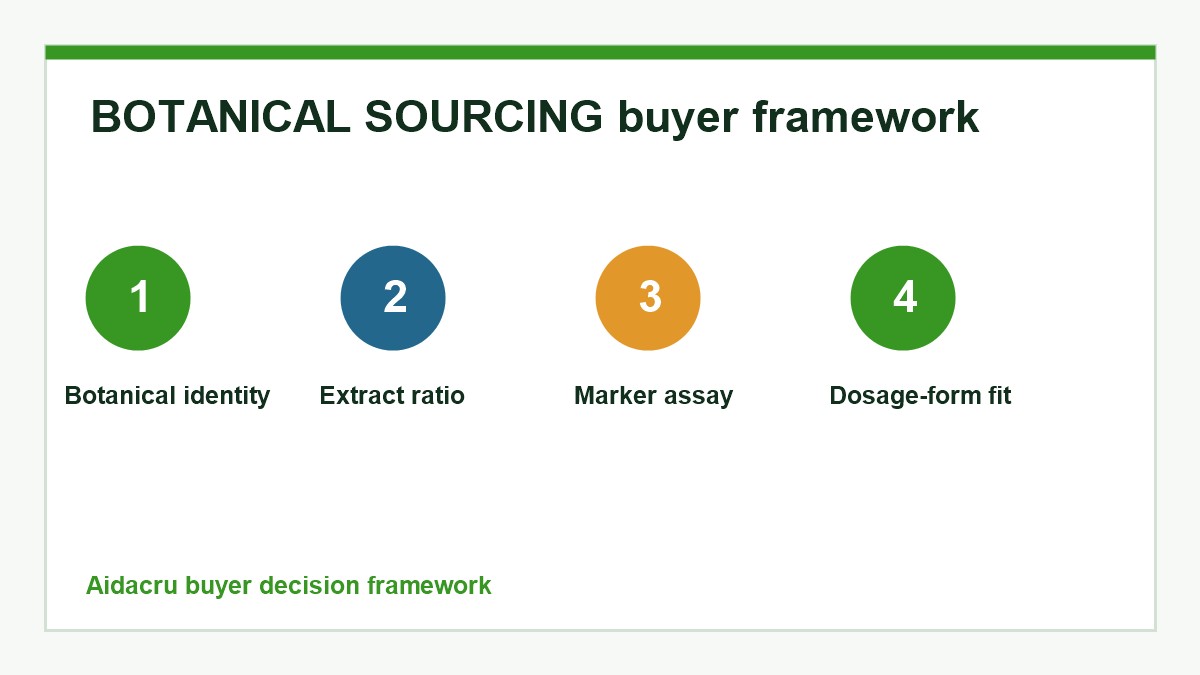
Extract Ratio and Assay Are Different
| Specification | What it indicates | What it does not prove |
|---|---|---|
| 10:1 extract ratio | Relationship between starting botanical material and final extract under the supplier’s process. | It does not automatically prove a specific active-compound level. |
| Standardized to 10% marker | A defined level of a measured marker or active compound. | It does not by itself establish complete identity, purity or clinical equivalence. |
| Whole-herb powder | Ground botanical material with limited concentration. | It may require a larger serving and has different sensory behavior. |
Botanical COA Review Checklist
- Common and Latin botanical name.
- Plant part used.
- Country of origin and traceability reference.
- Extraction solvent and carrier.
- Extract ratio and marker-compound assay.
- Identity test method.
- Heavy metals, microbiology, pesticide and residual-solvent limits where applicable.
- Batch number, dates and specification limits alongside actual results.
Identity Testing Matters
Color and taste are not sufficient identity controls. The appropriate method depends on the ingredient and processing level and may include microscopy, chromatography or other scientifically valid methods. Brands should confirm how the supplier’s identity result connects to the manufacturer’s component specification.
Dosage-Form Fit Changes the Buying Decision
A strong botanical powder can still fail in the intended product. Bitter extracts challenge gummies and liquid shots. Hygroscopic extracts can create capsule-flow or tablet problems. Dark pigments may alter appearance. Heat-sensitive constituents require careful process planning. The raw-material decision should therefore be reviewed together with the final dosage form.
Supplier Qualification Questions
- Does every batch follow the same written specification?
- Which laboratory and methods produce the COA results?
- Can the supplier explain extract ratio, assay and carrier clearly?
- Is a physical sample available before bulk purchase?
- Can documentation support the target market?
- Has the ingredient been evaluated in the intended gummy, capsule, powder or liquid system?
Avoiding Keyword Cannibalization
Aidacru already has a broad raw-material supplier checklist. This article targets the narrower search intent around botanical standardization, assay and extract ratio. It should internally support the raw-material category and the broader COA/MOQ guide rather than compete with them.
Related: Supplement Raw Materials · Raw Materials Supplier Checklist · Turmeric product option · Request botanical documents and samples.
Primary Sources and Market Evidence
Frequently Asked Questions
What is a standardized botanical extract?
A standardized extract is produced to meet a defined level of one or more marker compounds or actives under a written specification.
Is a 10:1 extract the same as a 10% standardized extract?
No. Extract ratio describes the relationship between starting botanical material and extract, while a percentage assay describes a measured compound level.
What should be checked on a botanical extract COA?
Check botanical identity, plant part, assay, extract ratio, carrier, contaminants, test methods, batch details and matching specification limits.