

P0 keyword: “Supplement OEM manufacturer” and “private label supplement manufacturer” are core commercial terms in Aidacru’s keyword-to-URL map.
Compliance signal: FDA 21 CFR Part 111 applies to foreign firms manufacturing supplements imported into the United States.
Conversion intent: Supplier-comparison questions occur immediately before sampling, factory review and RFQ submission.
OEM, ODM and Private Label: Define the Project First
| Model | Buyer provides | Manufacturer provides |
|---|---|---|
| Private label | Brand, packaging direction and market. | Existing or lightly adjusted formula and production route. |
| OEM | Detailed formula, specification or product benchmark. | Manufacturing, sourcing, testing and packaging execution. |
| ODM | Audience, benefit direction, format and commercial target. | Formula development plus manufacturing and packaging support. |
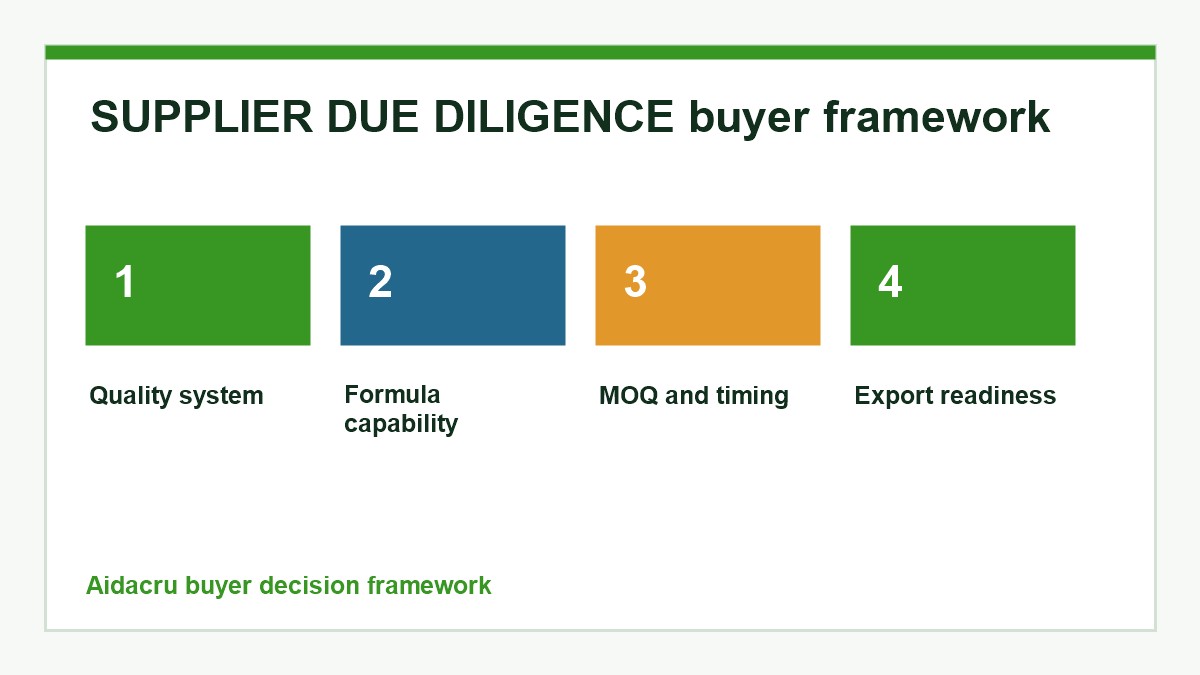
21 Questions to Ask Before Sampling
Quality and documentation
- Which quality system applies to the facility and product?
- Can you provide current, relevant certificates for review?
- How are incoming ingredients qualified and released?
- How are component and finished-product specifications established?
- What does the batch production record contain?
- Which tests are performed in-house and which are outsourced?
Formula and dosage-form capability
- Which dosage forms are produced routinely?
- Can the factory explain active loading and process limitations?
- How are flavors, colors and sweetener systems selected?
- What happens if the first sample fails sensory review?
- Can ingredients be sourced with traceable COA and specifications?
MOQ, timing and commercial terms
- What are sample, pilot and production MOQs?
- Which costs are one-time and which repeat every batch?
- What creates the longest lead-time risk?
- When does packaging need to be confirmed?
- How are change requests documented and priced?
Packaging and export readiness
- Which bottle, pouch, sachet, stick-pack or box formats are available?
- Who checks label dimensions and production files?
- Can shipping marks and export documents match the destination?
- How are retain samples and complaints handled?
- Who owns final regulatory and label approval?
Red Flags During Supplier Comparison
- The quotation does not define formula, dose, testing or packaging assumptions.
- Every product is described as possible without technical questions.
- Certificates are outdated, unrelated or cannot be matched to the facility.
- MOQ changes repeatedly after artwork begins.
- The supplier uses drug-treatment language in consumer claims.
- No written sample approval or specification process is offered.
Understanding FDA cGMP Expectations
FDA states that dietary supplement cGMP requirements apply to foreign firms that manufacture, package, label or hold supplements imported into the United States. Buyers should therefore ask how the manufacturer’s records, specifications, quality controls and traceability support the intended market. Certificates can support due diligence, but they do not replace product-specific documentation.
What to Include in the First RFQ
Provide the target market, dosage form, ingredient concept, daily serving, packaging type, expected quantity, target launch timing and any benchmark product. A complete brief produces a more useful feasibility response and prevents low quotes based on incomplete assumptions.
Why Aidacru Fits the Evaluation Process
Aidacru supports formula development, raw-material sourcing, multiple dosage forms, private label packaging, sampling and export-oriented project planning. Buyers can use this guide as the agenda for the first technical call and RFQ review.
Related: Aidacru supplement OEM manufacturer · Manufacturing · Private Label · Aidacru Supplier Fact Sheet · Submit an RFQ.
Primary Sources and Market Evidence
Frequently Asked Questions
What is the difference between OEM and ODM supplements?
OEM usually manufactures from a buyer-defined formula or specification, while ODM provides more product-development and formula-design support.
Does FDA dietary supplement cGMP apply to foreign manufacturers?
Yes. FDA states that the rule applies to foreign firms manufacturing, packaging, labeling or holding supplements imported or offered for import into the United States.
What information should a supplement RFQ include?
Include target market, dosage form, ingredients, daily serving, packaging, expected quantity, launch timing and any benchmark product.